Hi there! Need help? Chat with us on WhatsApp.
Start Chat
Hi there! Need help? Chat with us on WhatsApp.
Start Chat
Background
Have you heard of less-than-truckload (LTL) trucking? If you’re involved in the trucking or logistics industries, perhaps this is quite familiar to you. But if you are not, then today we are going to boil down everything you need to know about LTL trucking and then you can decide if this is suitable for your business use.
What is LTL trucking
LTL trucking is made up from numerous small loads from different shippers on one full truckload, and each shipper pays for the portion of what their cargo uses. LTL trucking is considered as a more cost-effective and flexible way to transport your goods.
How does LTL trucking work?
The LTL trucking journey can seem complex for new shippers that are unfamiliar, but actually, it is not that complicated. As mentioned before, LTL trucking combines multiple loads from different shippers to make a full truckload, which makes it have a lower trucking cost. Each shipper only pays for the space they used, rather than paying full price for the entire trailer. LTL shipments usually weigh between 60 kg and 6000 kg, and it is typically shipped using wood crates, wood pallets, or corrugated containers. Here is an overview of how LTL trucking works:
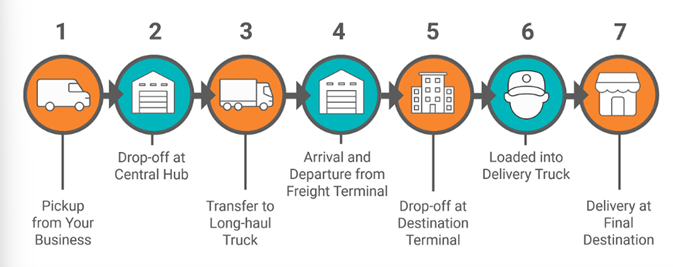
How long does LTL trucking take?
Because of the combined shipments with different shippers and multiple stops required, LTL trucking might take longer. Although some LTL carriers will give you an estimated transit time range, do expect delays in certain time. If you want to avoid this from happening, you should do in-depth research to find the ideal carrier, shorter and economic routes that allows you to track your shipment easily.
What affects the LTL rates?
1. Distance
Across the trucking spectrum, distance is always one of the most important factors to determine the trucking rates. The longer the distance between point A to point B, the higher the trucking rate will be. In LTL freight trucking, it is very important to understand the geographical coverage of the freight carrier before making the final decision. If your shipment is delivered to a location outside of their normal service area, you will need another truck delivery company to transfer your shipment to another LTL carrier for the final delivery, which will take even longer. Choosing the right and suitable carrier can avoid higher cost or additional charges.
2. Weight & Density
Weight and density are the most basic aspects of how carriers calculate the trucking rates. The weight of your shipment will directly impact the shipment’s density. In turn, this dictates what freight class your freight will be. To avoid the costly consequences that can result from inaccuracies, you need to measure the weight and density of your shipment properly, and put all the accurate information on a bill of lading (BOL) that is issued by the carrier.
3. Classification of freight
Once you have calculated the weight and density, you can now determine the freight classification. The freight class is essential information as it has a major influence on the overall LTL rate you receive. Product density, value, stow-ability, handling, and liability are the main factors that determine the freight classification. As a general rule, the higher the freight class, the more it will cost to ship.
4. Base rates
A base rate is the way that LTL carriers calculate the gross freight charges of a specific shipment. Usually, the base rate is based on the cost per hundredweight (100 pounds/ 45KG), also known as CWT. These carrier base rates are based on its volume, demand and gross costs. Typically, as the weight of your shipment increases the CWT rate decreases. You may check with your LTL provider to understand how they calculate their base rates.
5. Value added services
Another factor that determines the LTL rate is the additional services. Many LTL freight can be shipped with personalized services, including flexible pickup, residential delivery option, special trucks services and many more. These additions come with a cost and it is important to factor any special needs for your shipment so you will not be surprised by an invoice later.
Key takeaways
LTL rates can be reduced by working with an experienced freight provider like Spots logistics. We are one of the logistic companies based in Malaysia which connect shippers to reliable lorry transport companies. In addition, we also help companies to deliver heavy parcels more than 20kg, palletised loads and oversized items. We will be here to understand your trucking needs, guide you through every step, and provide the most effective solution at an affordable rate.
Get your quote and book online today: HERE
